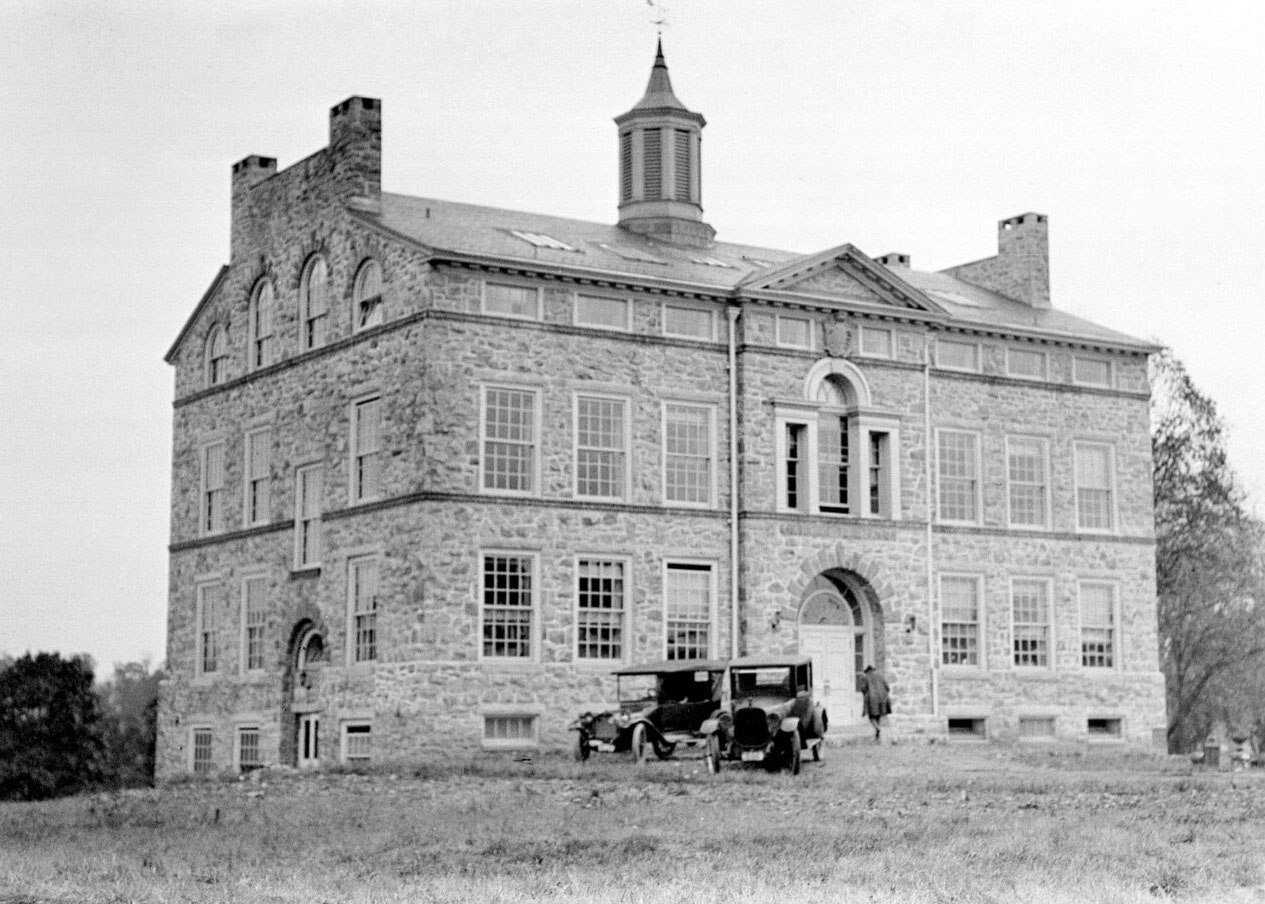
Photograph of Carnegie Hall at Morgan College (now Morgan State University) by Jackson Davis, 1921 November 3. Courtesy University of Virginia, 330943.
Some who post on the Facebook pages, such as Eli Pousson, do provide further commentary through websites from which the images are drawn. For example this photograph of Carnegie Hall, Morgan College on the Baltimore History- Baltimore City Historical Society Facebook page leads to an in depth study of civil rights in the city on a Baltimore Heritage web site.
Similar treatment should be given an album entry in Baltimore Old Photos for November 1, 2015, focusing attention on the police, inhabitants, and the neighborhoods encompassed by the Northeast district.
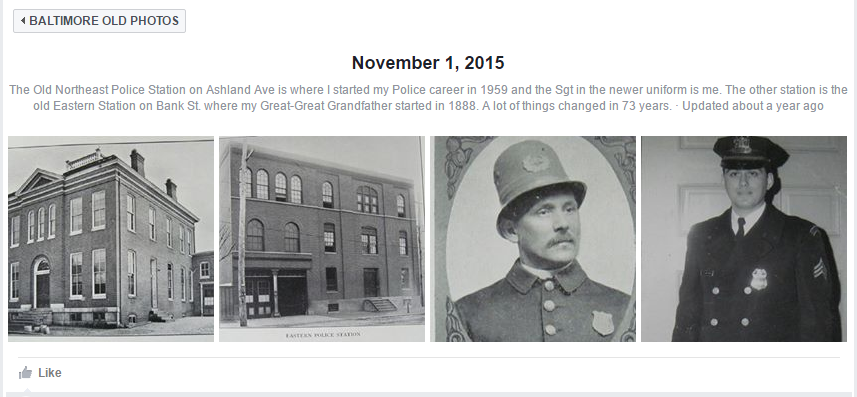
https://www.facebook.com/
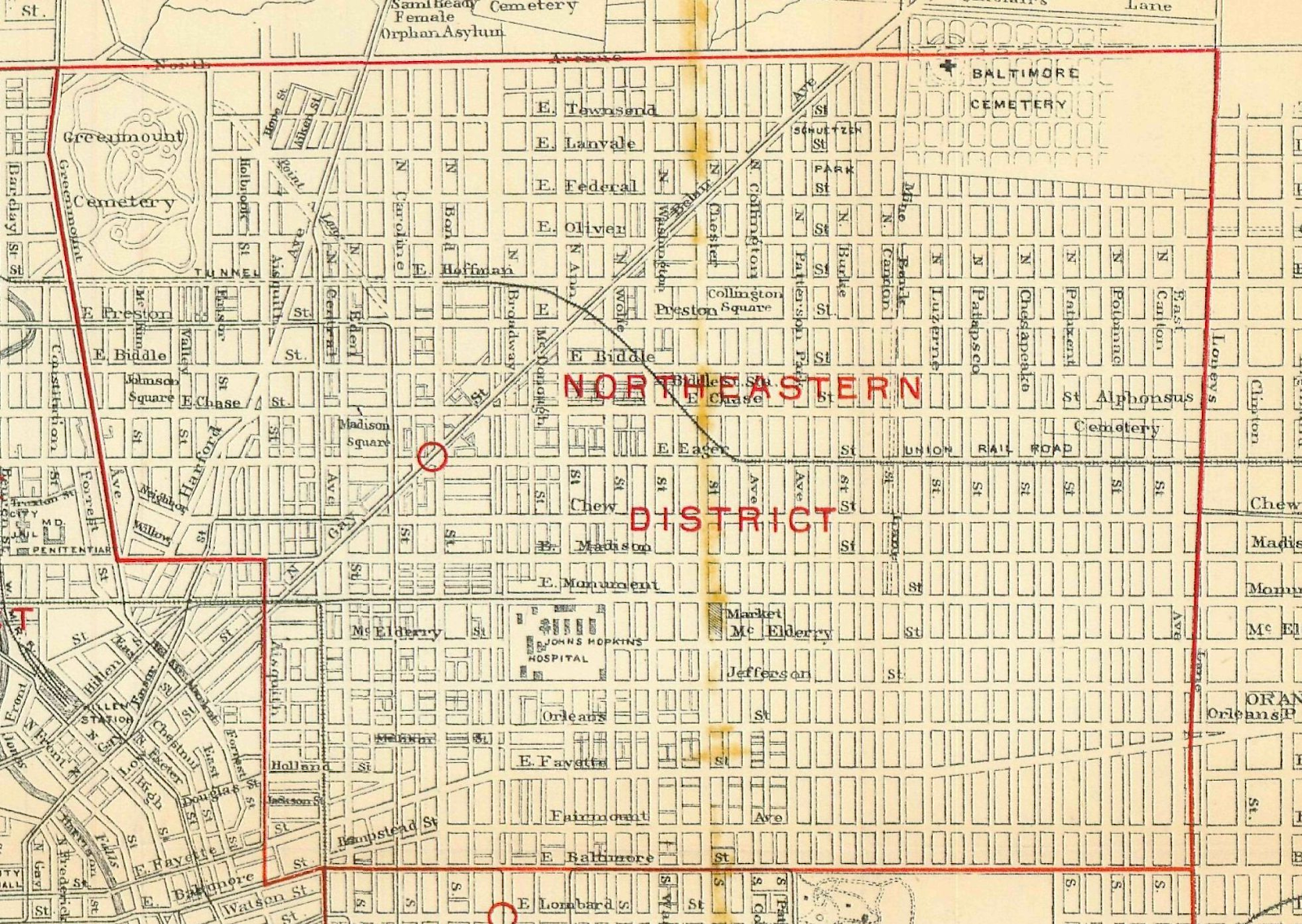
The outlines of the Northeastern Police district
are shown in a detail from this 1880 map (editor’s collection).
The original police station for the Northeastern Police district is now owned by Johns Hopkins University, and is today the Johns Hopkins Berman Institute of Bioethics at 1809 Ashland Avenue.
Hopkins Berman Institute Of Bioethics
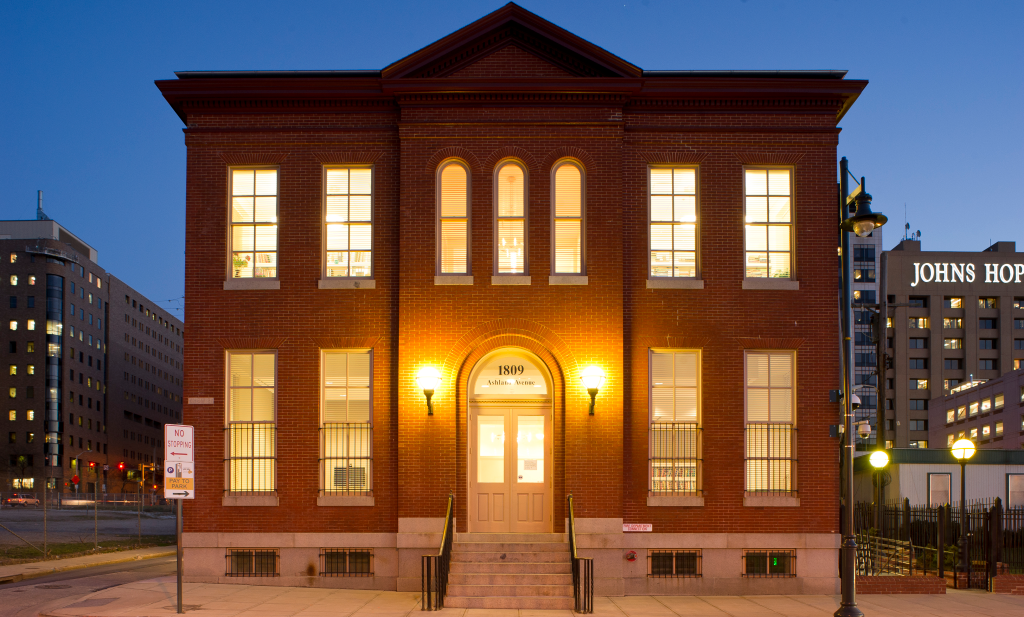
the Johns Hopkins Berman Institute of Bioethics at 1809 Ashland Avenue
The early police dockets for the Northeastern district which contain a running narrative of neighborhood events that are not all criminal, are available at the Maryland State Archives:
(Criminal Docket, Northeastern District)
1876-1878, 1900-1952, 1956-1959
In preparing this posting of Remembering Baltimore, I came upon another blog of Baltimore history that is no longer active, and may eventually disappear from the airways like many other blogs and websites. The domain name, charmcityhistory.com, like that of Yahoo’s GeoCities, is already owned by some entity offshore, and is no longer linked to David Mantione’s http://charmcityhistory.
As a service to my readers, this posting of Remembering Baltimore is devoted to a review of what was published in http://charmcityhistory.
In an earlier version of this blog I was overly optimistic with regard to when some articles were scheduled to appear, and even doubted at times that the blog would last more than a year (it didn't). I have concluded, however, that as long as there continues to be an interest in the approach to the history of Baltimore City as reflected here, I will continue to publish the topics previously announced.
For example the Now and Then column, will return in a future issue with an essay on the Johns Hopkins Colored Asylum on West 31st Street, its ‘inmates’ (a term used by the U.S. Census Bureau), and its neighbors across the street.
Recently travel in New Zealand and Hawaii has also brought to my attention the neglected stories of three wartime connections to Baltimore,
- a mother from New Zealand, working as a maid in Baltimore whose son died in the Dardanelles during the First World War,
- a baker’s assistant, born and raised on Lombard street, who took some of the most important photographs in the history of the Battleship Missouri and whose parish has disappeared without a trace, save a once impressive Roman Catholic church,
- a New Zealand born graduate of City College who died in Vietnam, and whose name is carved into two walls of remembrance, one in Auckland and the other in Washington, D. C.
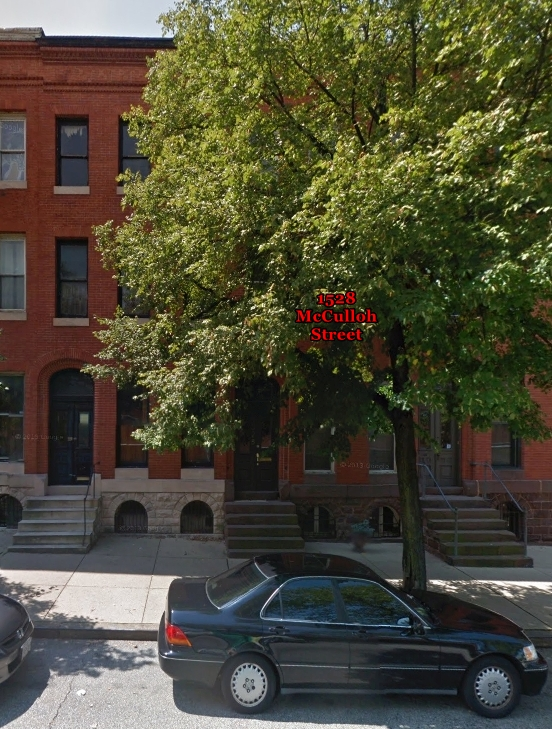
Also I will follow through on Is There a Doctor in the House, a story about an MD/inventor/lyricist, Dr. David Newton Emanuel Campbell who lived and had his offices on North Carey and McCulloh streets. In the meantime, the best site to begin any study of Doctors who practiced, or were educated in Baltimore prior to 1920 is Medicine in Maryland, a website created and maintained by Nancy Bramucci Sheads.
I encourage readers to submit essays of their own to rememberingbaltimore@gmail.com, and to communicate with me by the messaging system you will find to the right just below the masthead on this blog.
If you have a story to share about neighbors and their neighborhoods, or any other short narrative (500-700 words) related to the history of the city, send it to rememberingbaltimore@gmail.com. Contributions are welcome, as are suggestions for future issues of the Remembering Baltimore. Note that if you include graphics with your submittals, be sure to cite sources. Note also that if you place your graphics within the text of your essay using Word or a generic word processing program such as that provided by Google Drive, it will make it much easier to publish in this newsletter/blog.
Until next time …
Ed Papenfuse
Editor, and former State Archivist of Maryland
From The Charm City History Blog:
As a service to the readers of Remembering Baltimore a synopsis of the table of contents of http://charmcityhistory.
"A Little Treasure Chest from Baltimore's Attic"
Table of Contents:
- ▼ 2014 (7)
- ▼ July (1)
- ▼ June (1)
- ▼ May (1)
- ▼ April (1)
- ▼ March (1)
- ▼ February (1)
- ▼ January (1)
- ▼ 2013 (27)
- ▼ November (1)
- ▼ October (2)
- ▼ September (2)
- Baltimore Inventors/Inventions: The Famous and Not...
- Faded Hints of the Past Series: Border State Savin...
- ▼ August (2)
- ▼ July (1)
- ▼ June (1)
- ▼ May (2)
- ▼ April (2)
- A Sweet Baltimore Discovery at Johns Hopkins Unive...
- Early Baltimore "Wireless Telephone" (Radio) Stati...
- ▼ March (4)
- The Lasting Products Company - Baltimore City's "L...
- It's 2 O'clock. Do You Know Where Your Husband Is?...
- Celebrating the Marvels of Light at 39 West Lexing...
- The Paint and Powder Club - Early Baltimore Drag
- ▼ February (6)
- Union Trust Building - One of the Great Survivors
- The American Odd Fellows - Birthed in Baltimore
- The Baltimore General Dispensary (1801-1959)
- The Struggle for Baltimore's First Parking Meters
- Baltimore News - 120 years ago
- Molasses and Stowaways at Domino Sugar
- ▼ January (4)
- Everyman Theatre Building - An Immoral Past
- "Drop the Monkey" - Early Elevator Testing Methods...
- "Born in Baltimore, Raised Everywhere"
- Knickerbocker Ice Company in Baltimore
The Cost of Breaking the Law in Baltimore -
125 to 200 Years Ago
By David Mantione
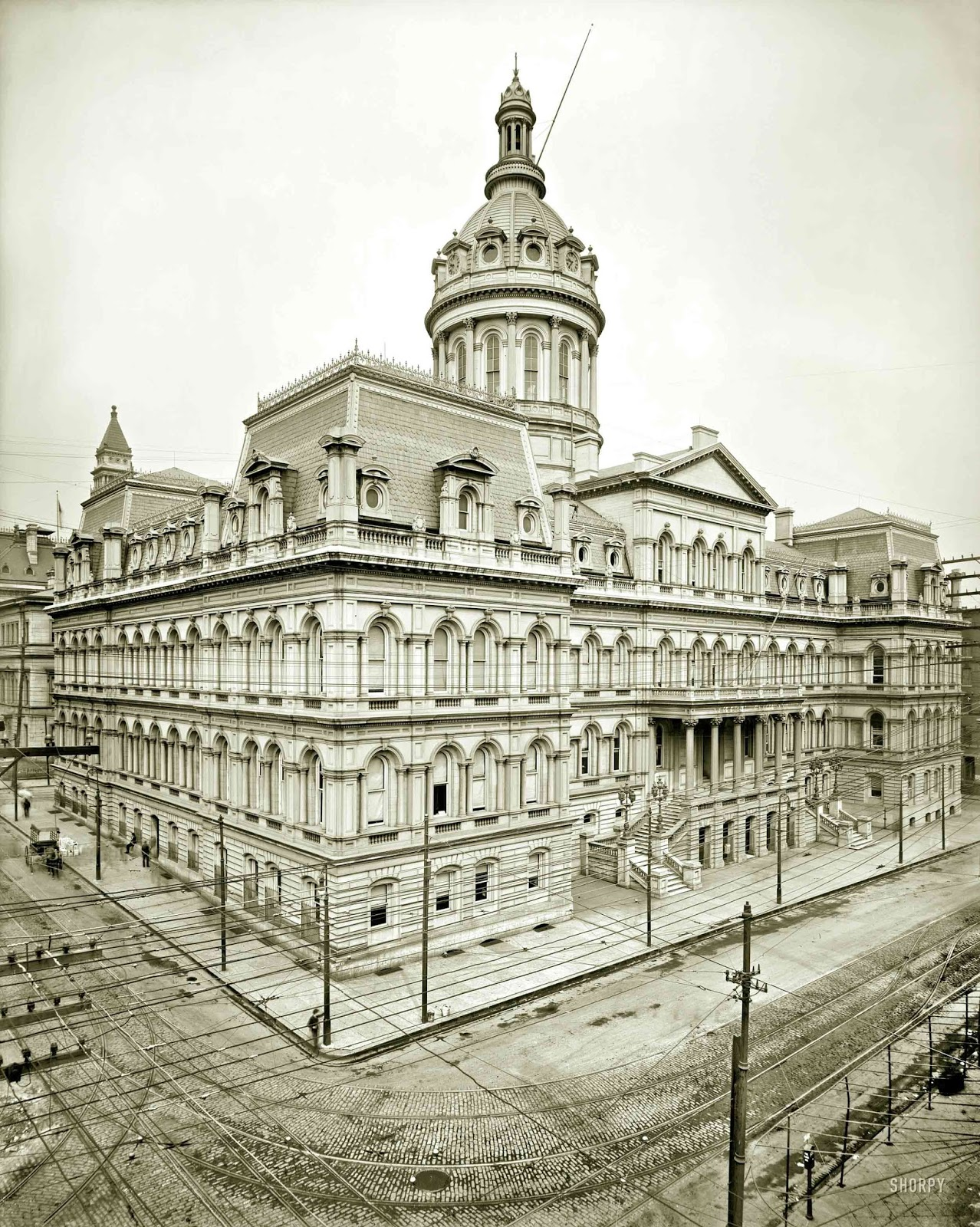
Baltimore City Hall (c1900)
Detroit Publishing Company
(Courtesy: Shorpy.com)
One would be surprised as to what you might get arrested for in violation of Baltimore City Ordinances between 125 and 200 years ago in Baltimore City. Public law in early Baltimore City was written and enacted in response to the pressing issues of the day (health, safety, wrongs against individuals and public property) as was the case in many developing cities within the United States and around the world. Current Baltimore City laws and ordinances have citations deriving from City Code as far back as 1879.
What follows is a collection of offenses from the period of 1801 to the 1870s, along with associated fines for violating the ordinance or code. It has been determined from actual Baltimore City Ordinance of the period or from court judgments and/or arrests as noted in Baltimore Sun legal articles. So as to impress upon today's reader the magnitude of the fine, each of the fines for offense are indicated by value in today's U.S. dollar.
1801 (as noted in Ordinances of the Corporation of the City of Baltimore)
- Driving a carriage, caravan, wagon, sleigh, cart, etc in the middle (as opposed to the right side) of the street - FINE, $14
- Cock fighting of any kind within the City Limits - FINE, $271
- Gun or pistol which is willfully and needlessly shot or discharged within the City - FINE, $68
- Bringing damaged coffee, hides or other damaged or infected articles into the city limits, by land or water - FINE, $4,070
- Operating the performances or exhibitions without a license (See below, for license cost): - FINE, $13,565
Licenses were required for the following: Circus or theatrical exhibition - $109 / performance; Rope or wire dancing, or puppet shows - $136 / week; Musical parties for gain - $68 / week; All other public exhibitions - $27 / week
1840s (as noted from Baltimore Sun Public Notice, Court Judgments)
- Washing salt sacks in a tub placed under a pump in public - FINED, $37 plus costs
- Throwing rubbish into the street and permitting it to remain there - FINED, $22 plus costs
- Permitting wood to remain upon a wharf longer than 2 days - FINED, $5.50 daily / foot of ground
- purchase or sale of wood without a license - FINED, $44 / each cord sold
1850s (as noted from Baltimore Sun, Public Notice of Court Judgments)
- Throwing stones in public - FINED, $27
- Running wagons without license numbers - FINED, $27-$50
- Improper conduct in the presence of ladies - FINED, $121
- Throwing a nuisance in the street - FINED, $27
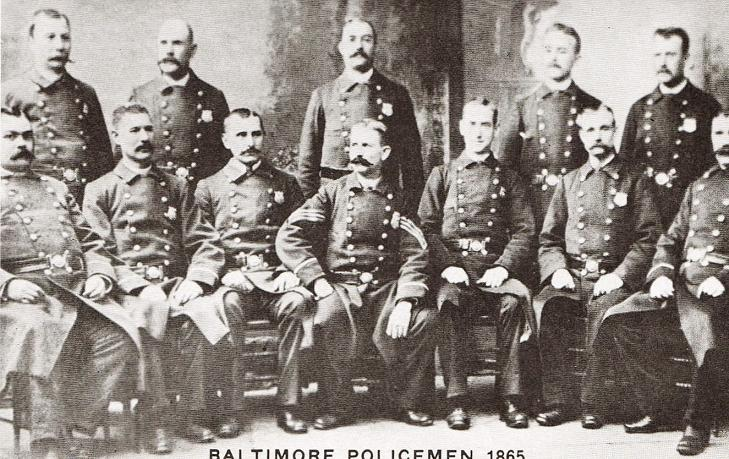
1860s (as noted from Baltimore Sun, Public Notice of Court Judgments)
- Allowing a ten-pin alley to be used after 11 o'clock at night - FINED, $252
- Exposing unsound meats for sale - FINED, $504
- Bathing in the Jones Falls - FINED, $17
- Boys were arrested for jumping upon one of the Philadelphia Railroad cars while in motion - FINED, $17
- Running against and breaking a city lamppost - FINED, $85
- Throwing nauseous liquors on the street - FINED, $85
- Immoderate driving in the street - FINED, $85 plus costs
- Gambling on Sunday - FINED, $85 plus costs
- Permitting gambling on premises - $510 plus costs
- Carrying on a distilling business on McElderry's wharf without a license - SENTENCED TO PAY FINE OF $3,236 AND IMPRISONED UNTIL PAID. [Of interest: Within 6 months, the convicted, Thomas Carr, received a pardon from the President of the United States, which remitted the fine and he was immediately released]
1870s (as noted in Ordinances of the Corporation of the City of Baltimore or Baltimore Sun)
- Killing or attempting to kill, or in any manner injure or molest sparrows, robins, wrens, or other small insectivorous birds in the city of Baltimore, to include their birdhouses - FINE, $85 per offense
- Playing cards on Sunday - FINED, $24
- Carrying a concealed razor on his person - FINED, $72
These are in interesting contrast to EXISTING ordinances within the City of Baltimore:
- Tossing, throwing, flinging any object capable of being thrown or used as a projectile (excluding paper wrappers) on the playing field or arena, official or any member of the team at a sporting event - FINE, up to $1000 or imprisonment up to 12 months (misdemeanor)
- Playing, singing, or rendering the "Star Spangled Banner" anywhere publicly in the City of Baltimore, except in its entirety in composition, separate from any other melody. Likewise, it cannot be played for dancing or as an exit march. - FINE, not more than $100 (misdemeanor)
- Sell, give away or dispose of a "toy cartridge pistol" within the City Limits of Baltimore - FINE, $10.
- To discharge or fire a "toy cartridge pistol" - FINE, $2.
- Unauthorized by any person not of the Department of Public Works within the City Limits of Baltimore to remove recyclable materials from designated containers without approval from the owner or operator of the recycling operation - FINE, up to $500 (misdemeanor)
"Reddy the Bull" Predicted Baltimore Motorists' Disgust in Traffic Lights
By David Mantione

City Traffic, Early 1920s
Within years of the automobile being introduced to Baltimore City streets, the issue of traffic had become a major problem where both patrolmen and/or traffic signals were used to control movement at congested intersections. Besides cars and trucks, traffic included street cars (vehicles traveling on rails) and horse-drawn vehicles. While they all obeyed a general principle of staying to the right on two-way roads, beyond the confusion at busy intersections, it was becoming outright dangerous.
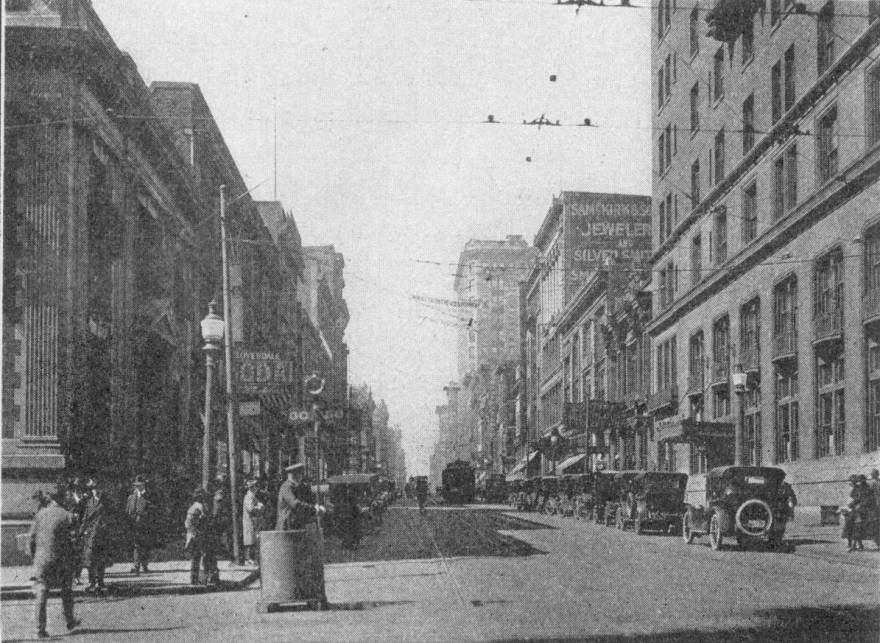
Baltimore City Policeman with
Semaphore, circa 1920
(Courtesy: Kildruffs.com)
As was the case in many bustling cities of the day, at first, whistle blowing and arm waving patrolmen attempted to provide order to the chaos. As early as April 1915, the Baltimore City Police Department had traffic police officers operating 'newfangled' signals upon long poles (or semaphores) having narrow paddles which were painted red on two sides with a bold white "STOP" - they were first trial implemented at the corner of Park Heights and West Belvedere Avenues. Traffic policemen operating semaphores were widely used for a period of five years and often removed depending on the perception of their merit as opposed to the sole whistle and wave of patrolmen.
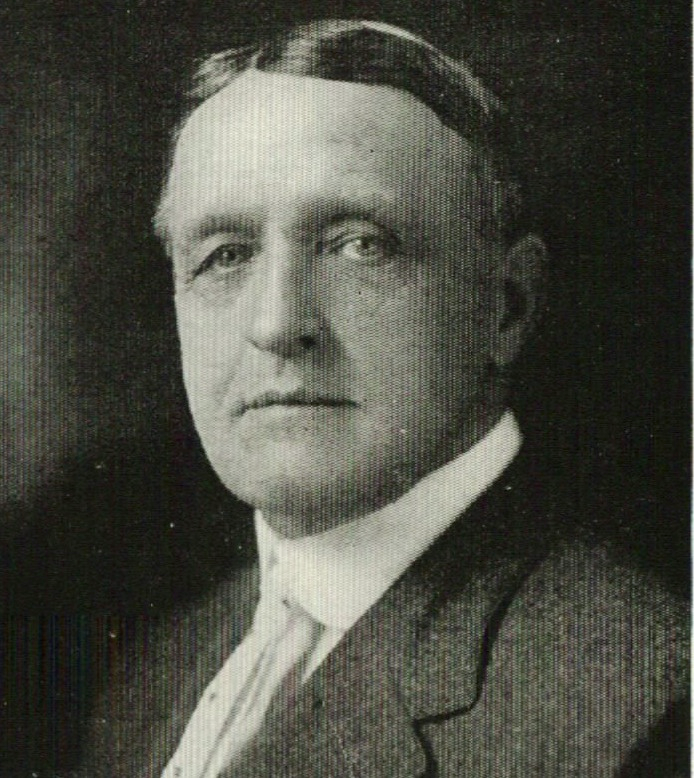
Gen. Charles D. Gaither
Baltimore City Police
Commissioner (1920-1937)
On June 1st, 1920, a man by the name of Brigadier General Charles D. Gaither, previously commander of the First Brigade, Maryland National Guard began his duties as the Governor-appointed first Baltimore City Police Commissioner. Called "The General," he took Baltimore City traffic seriously and would personally drive through downtown city streets observing the manner in which traffic was handled, especially during rush hour.
By July 1921, under his direction, the Police Department placed fourteen six feet high "lighthouses" on concrete bases which were intended to warn motorists of dangerous curves and bends at night. The flashing lights in the lighthouses were fueled by acetylene tanks (see photo, below and left) - red flashing indicated places where people had been killed, yellow for dangerous curves or bends where caution must be exercised, and green was for danger at intersections where slow, careful driving should be exercised to the right.
The earlier days of traffic lights and warnings resulted in disgruntlement by drivers and even beasts. Prior to placing the traffic lights on streets with protective bases, they were continually run over by motorists refusing to stop. On October 16, 1923, the Baltimore Sun reported that a certain Jersey bull by the name of Reddy had created a riot in the middle of the congested intersection of Bryant and Pennsylvania Avenues while being led to slaughter. A heard of 40 bulls were being driven down the avenue where automobiles stopped in obedience to a blinking red light, but not Reddy who saw it as a challenge and proceeded to charge it. In the charge, a truck struck and broke its leg before he could reach his "enemy." Unfortunately, agents of the SPCA needed to kill the Reddy earlier than his originally intended fate.
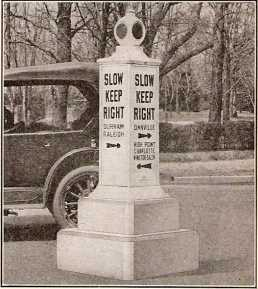
Acetylene Traffic Beacon
General Gaither refused to bring "automatic" electric traffic signals to Baltimore City until the Fall of 1925 since he felt that devices on the market prior to then were inefficient in regulating and safeguarding traffic, effectively still in experimental stages. On St. Patrick's Day of 1926, all semaphores at congested intersections between the north-south Gay and Greene streets and east-west Center and Pratt streets were replaced by automatic electric signals, interestingly controlled by one manned traffic tower - all changing at exactly the same time. The Baltimore Sun further reported that thoroughfares like Cathedral and St. Paul streets and Mount Royal, North and Pennsylvania avenues would be operated independently by a traffic tower on each thoroughfare controlling all signals on that street.
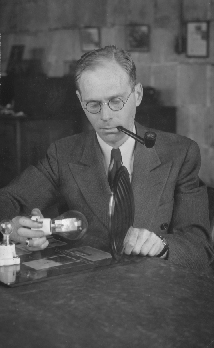
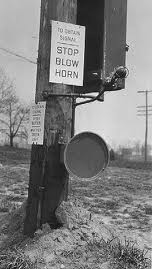
Native Baltimorean, Charles Adler, Jr. (1899-1980) and Sound-activated Traffic Light - Adler Invention
Automatic signals were a change for motorists as they were used to patrolmen hesitating changing a semaphore against an aggressive driver. In contrast, with automatic signals, drivers would know that the signal won't hesitate and that drivers in the opposing direction would move the instant they saw their green signal. Savings were envisioned from reduced manpower, yet for a period policemen were stationed at intersections until motorists and pedestrians were educated to the necessity of observing the signals. Initially, the colors used were RED for stop, WHITE for change, and GREEN for go.
While these traffic lights were "automatic" to motorists, they were still controlled by a patrolman located in a tower. True automatic traffic signals were actually invented by a gentleman by the name of Charles Adler, Jr. who was native to Baltimore. An avid inventor, he invented a sound-activated traffic light (see figure, above, right), pavement traffic light sensors, and a list of many other inventions. For all those motorists passing through Baltimore City streets, beware of camera activated ticket lights. Charge those traffic lights like Reddy the Bull and, while you won't meet his similar fate, you will be certain to receive a citation - you just won't have Charles Adler or General Gaither to blame for it. (Sources: Baltimore Sun Newspaper articles, and Kildruffs.com)