Tuesday, November 27, 2018

Teacher & Poet: Lizette Woodworth Reese (January 9, 1856 – December 17, 1935)

Teacher & Poet

What do these three images excerpted from Google Earth have in common?
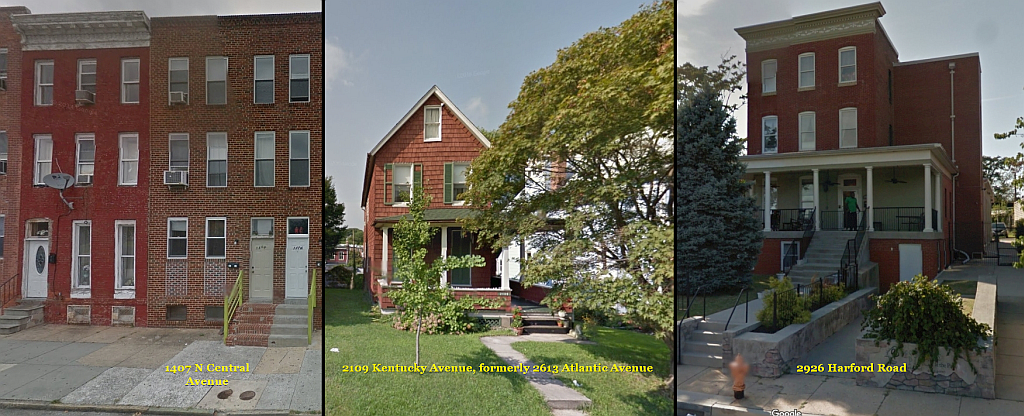
These are the homes in which the acclaimed Baltimore poet, Lizette Woodworth Reese lived a large portion of her adult life. Recently, thanks to the efforts of BCHS member and secretary, Joe Stewart, among others, Miss Reese, who received an honorary doctorate for her poetry from Goucher College, has been admitted into the Maryland Women’s Hall of Fame.


The Pratt Library houses her papers and the Maryland Historical Society’s Underbelly has published a well written and thoughtful account of her life and career from which the following photograph is taken.
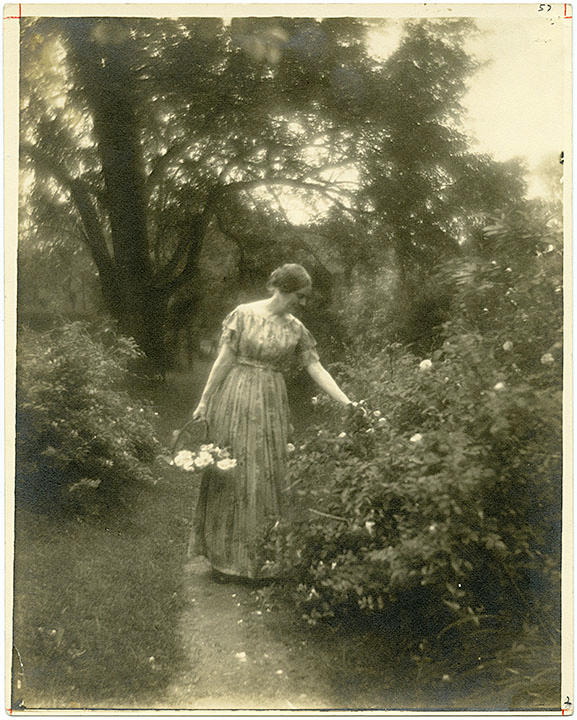
http://www.mdhs.org/underbelly/wp-content/uploads/2015/04/pp92-135.jpg

Lizette Woodworth Reese published her first poem, “The Deserted House” in the June 1874 issue of Southern Magazine (Baltimore, Turnbull Brothers), perhaps written nostalgically from a new home on Harford Avenue, no longer extant?[1]

The Deserted House

THE old house standeth wide and gray,

With sharpened gables high in air,

And deep-set lattices, all gay

With massive arch and framework rare;

And o’er it is a silence laid,

That feeling, one grows sore afraid.

The eaves, are dark with heavy vines;

The steep roof wears a coat of moss;

The walls are touched with dim designs

Of shadows moving slow across;

The balconies are damp with weeds

That lift thick as the streamside reeds.

The garden is a loved retreat

Of melancholy flowers, of lone

And wild-mouthed herbs, in companies sweet,

’Mid desolate green grasses thrown;

And in its gaps the hoar stone wall

Letteth the lonesome ivies fall.

The pebbled paths drag, here and there,

Old lichened faces, overspun

With silver spider-threads —they wear

A silence sad to look upon:

It is so long that happy feet

Made them to thrill with pressure sweet.

The fountain stands where crowd the trees,

And. solemn branches o er it part:

HOW human wind its melodies!

“A broken heart—a broken heart! "

For this is all it hath to say

Throughout the livelong summer's day

...
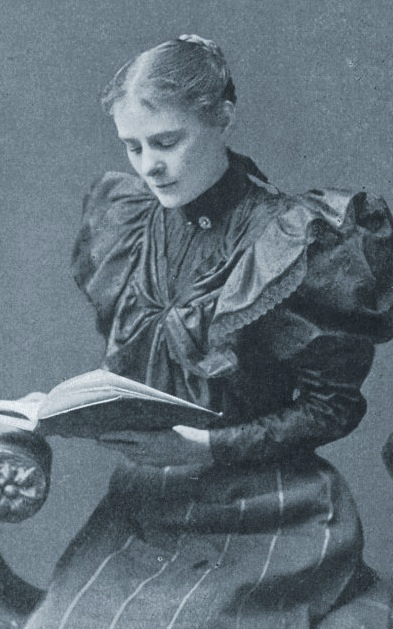
MISS LIZETTE WOODWORTH REESE

imaged published in the Sun March 15, 1903, pg. 7, background removed; said to be taken some years before;

source: http://americanliteraryblog.blogspot.com/2011_12_01_archive.html, location of the original, unknown

Lizette Woodworth Reese began teaching at St. John’s Episcopal school in Waverly. She then moved to the public schools of Baltimore City in 1876 to teach at the English German School. In 1889, at the age of 33, she first appears in her own right in the city directory as a teacher living at 1407 North Central Avenue, residing with her parents and brother David In 1896 she transferred to teach at the Colored High School on Saratoga, just east of Charles Street and next door to the Athenaeum, home at the time, to the Maryland Historical Society.
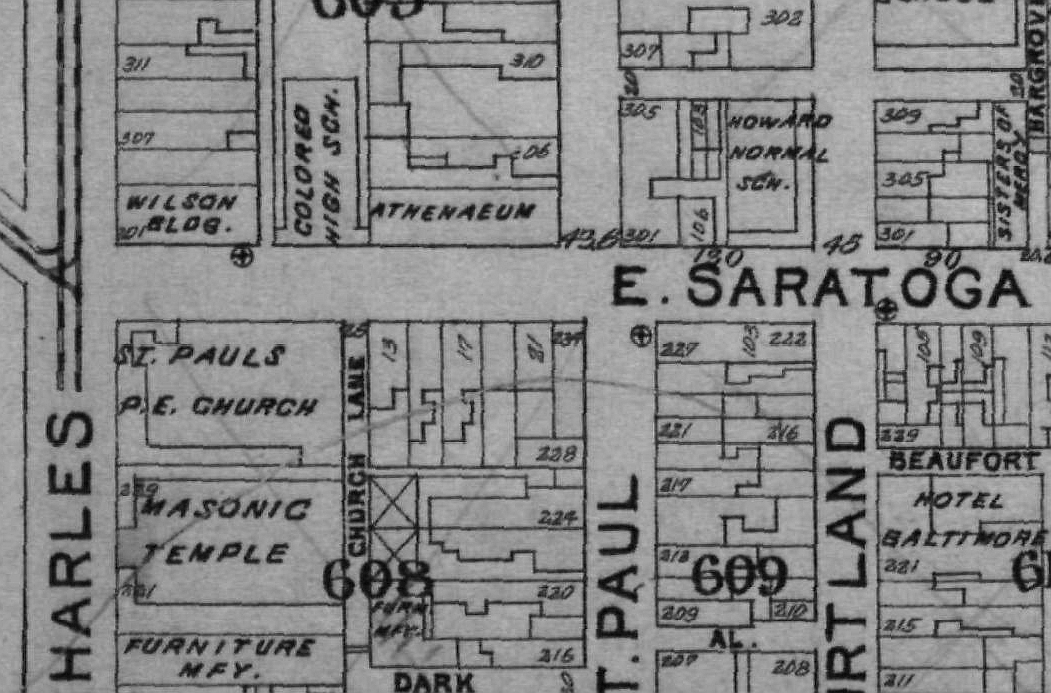
detail from the Bromley Atlas of Baltimore City, 1898

There she taught composition, rhetoric, literature, and physiology until 1901. In 1897 she bought the house at 2613 Atlantic Avenue (now 2109 Kentucky) for $650, the equivalent of her annual salary at the Colored High School. In 1917 she sold the house and moved in with her sisters at 2926 Harford Road, today an assisted living facility overlooking Clifton Park, where she remained until her death in 1935.
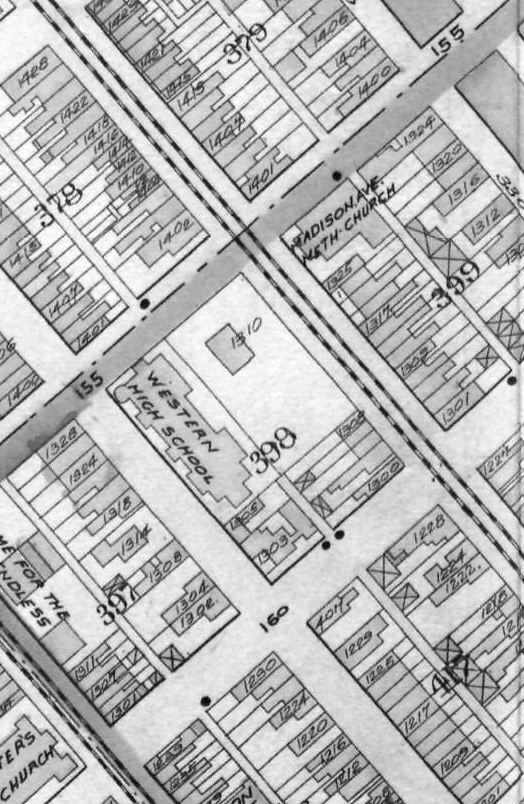
Western High School on McCulloch Street, detail from 1906 Bromley Atlas of Baltimore City

When in 1901 the city finally fulfilled its ‘promise’ to staff all colored schools with colored teachers, Miss Reese was transferred to Western High School, where she remained until her retirement in 1921, after which she devoted herself to writing and reading her poetry.
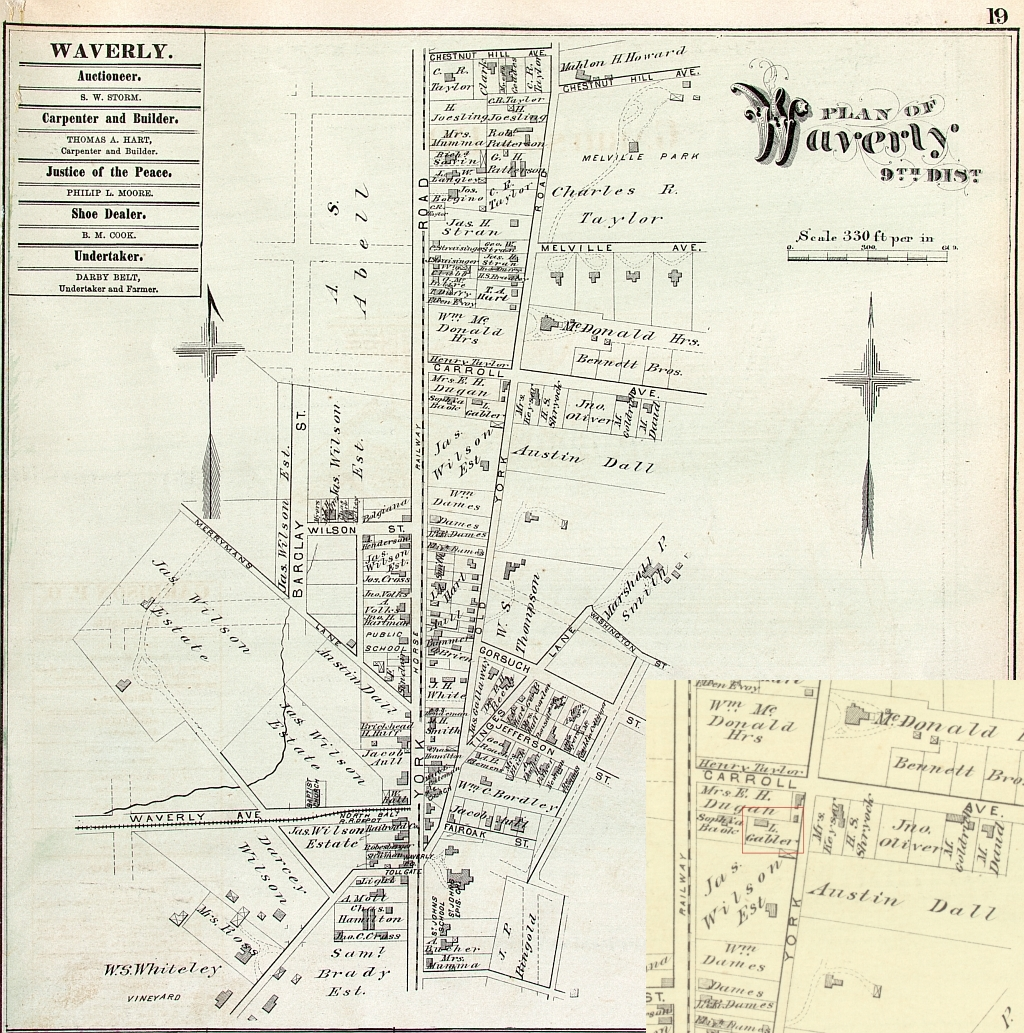
image of an 1877 plan of Waverly, then in Baltimore County, courtesy of Johns Hopkins University, Sheridan Library

Most of her published works reflect on, or are inspired by, her memories of the Waverly neighborhood. As one of the chief advocates for her inclusion to the Maryland Women’s Hall of Fame, BCHS member and recording secretary, Joe Stewart, points out:

Two somewhat biographical books refer to grandparents east of Macdonald estate ( which Abel purchased) which I believe to be slightly north of the then non-existent 33rd Street.

She went to school and later taught at St. Johns (Huntingdon) and was active in that church now called St Johns in the Village on Greenmount at Old York.

In A Victorian Village she writes [in a chapter entitled “The House]

A half mile away from the old house [whose house? it reads like "hers"!] stood the toll-gate [that would be the toll-gate close to present day Greenmount and Vineyard across the way from St. Johns. And then writes] For an imaginative child living on the York Road, to wake up and remember the closed toll-gate half a mile below, [suggesting she was half a mile above or north] and the closed one farther up the pike [Govans?] was to have a feeling of safety not to be put into words. ... When I thought, years after, of the pastures in front of my grandfather's house, a line of one of Watts's hymns - "Green fields beyond the swelling flood" - came into my mind. … Opposite stretched a great pasture, curving down into the great western sky...The air was full of prickling half-noises...the shrill of the peacocks across in the Macdonald Farm...But houses go. The town pushes out, and clutches the fair meadowlands, and the uneven lanes are straightened into uniform streets, and the few roofs give way to hundreds, each after the same fashion, and the single shop to a sprawling dozen. And this was the way of the old house. They [her German grandparents?] built a new one on the opposite side of the orchard, and transplanted the white lilac-bushes...It grieved my childish heart to see the enchanted place go, but by this time my parents had moved into the city, and my only glimpse of the devastation were those of occasional week-end visits; being out of sight kept it in part of my mind. … There was never much money; many of this world's goods I went without. But there were always daffodils in the grass in spring, and there were traditions, and books, and plain thinking, and direct speech, and dignity of life and work, and liberty to move about, and grow up in. And which of us can escape beauty, no matter in what guise or

under what name it goes about?

Francis P. O’Neal of the Maryland Historical Society takes the location of her childhood memories even further:

If you go to entry No. 390 in the 1860 census of the Ninth District of Baltimore County, you will see Lizette Reese listed with her maternal grandparents, the Gablers, in Waverly. The question thus becomes ‘Where did the Gablers live?’. On the ‘Plan of Waverly’ which you will find in the 1877 Hopkins’ “Atlas of Baltimore County, Maryland” you will see a house labeled ‘L. Gabler’ just south of the southwest corner of Old York Road and Carroll Ave. This was the home of Louis Gabler, who I suspect (but so far cannot prove) was Lizette’s uncle on her mother’s side. Louis Gabler also showed up in the 1860 census of the Ninth District of Baltimore County; he was listing No. 388, meaning he was pretty close to grandpa Charles Gabler [no. 390] and Lizette. You’d have to root around among the Baltimore County deeds of the period to see if by the time the 1877 atlas was made Louis Gabler had taken over what had been Charles Gabler’s house (although Charles didn’t die until 1880) or whether Louis was at the corner lot all along (i.e. from 1860 through 1877) and Charles had another, nearby, house that isn’t marked on the 1877 Waverly plan. In either case, I’m pretty confident that Lizette grew up around the intersection of Old York Road and Carroll Avenue – which latter today is East 35th Street – since I’ve never found any reason to doubt it.

P.S. Louis Gabler still was living at what then was No. 188 Old York Road in 1903, when his wife died there.

Indeed if you look closely at the 1877 map, you can see the Louis Gabler’s property extends to another house on Carroll Street which most likely was either Louis’s or Charles’s house. It also may be the property on which “Little Henrietta” died to whom she dedicate “her first long poem” in 1927.

The house itself was a low, mellowed thing,

In part of brick, in part of faded wood;

Set for a century in the four great winds,

Set in its years as in a mist of rain

At edge of twilight, when a narrow sound,

Silver in silver air,

Pricks through each crack of the short, half-lit hour,

Such was its look and with that look was bound

That of dim, fast-kept Aprils, crowded close,

At every chimney, and about each door

That April came when she was four years old,

And passed. And crowding on sad August came.

Picked to the bone our roads lay in the blaze

Of sun. On the cracked hedge a month-olddust

Stuck thick as meal from top-twigs to the roots;

Each sound struck like a stone

Dropped into a choked well. By the peeling fence

Our dahlias lighted a flat, scarlet blaze,

Seen a field’s length across the stretched, hot land.

Blare, silence, draught. Then, of a sudden, Death!

In the same “A Victorian Village,” published in 1929, so clearly based on those memories of growing up in Huntingdon, now Waverly, she also pays glowing tribute to public school teachers, her chosen profession:

A teacher’s work is not obvious; it is often obscure; it is not set to the blare and flourish of trumpets ...In passing a public-school building, every American citizen should feel like uncovering his head, in salute to those within who are spending their span of years in the nobilities and sacrifices of the spacious, most ancient of professions. [quoted in the Sun, June 27, 1942, p.6]

No one will know for certain how many young minds she stimulated by her presentations in the classroom. At the colored high school on Saratoga street, founded by her principal, Reverend George Lewis Staley, 65 of the graduates she taught between 1897 and 1901 are listed by name in the Annual Reports of the Baltimore City School Commissioners. Their biographies have yet to be written, and their neighborhoods remain unidentified.[2] The same is true of the hundreds of women she taught at Western High School, including those she continued to meet with in retirement at her home on Harford road.

For a bibliography of her published work see: Alexander Wirth, Complete Bibliography of Lizette Woodworth Reese, 1937, available on line at http://catalog.hathitrust.org/Record/007921827.

It is perhaps fitting to conclude with Wirth’s flowery tribute to Miss Reese in his introduction:

While singing the praises of a lovely little lady a great fear haunts me lest my effort prove unworthy of her genius. Henry L. Mencken ranked Miss Reese with Edgar Allan Poe, and well he may, for he is not alone in his high tribute. Amy Lowell said that “her ‘Tears’ was as fine a sonnet as any by Elizabeth Barrett Browning.”


[1] from 1870 to 1887 David Reese, carpenter, Lizette’s father?, is listed as living at 392 Harford Avenue in East Baltimore (City directories).

[2] one such graduate was Katie Locks. According to the family historian, Mary Katherine Locks (1882-1959), was the granddaughter of John W. Locks, a prominent mortician. She married John Wesley Woodhouse. To date no one has undertaken class histories of the known graduates of the colored high school, or for that matter, individual biographies

Wednesday, October 3, 2018

Baltimore Constable and Police DetectiveThomas W. “Tom” Gorman (1821-1863)

Baltimore Constable and Police Detective

Thomas W. “Tom” Gorman (1821-1863)

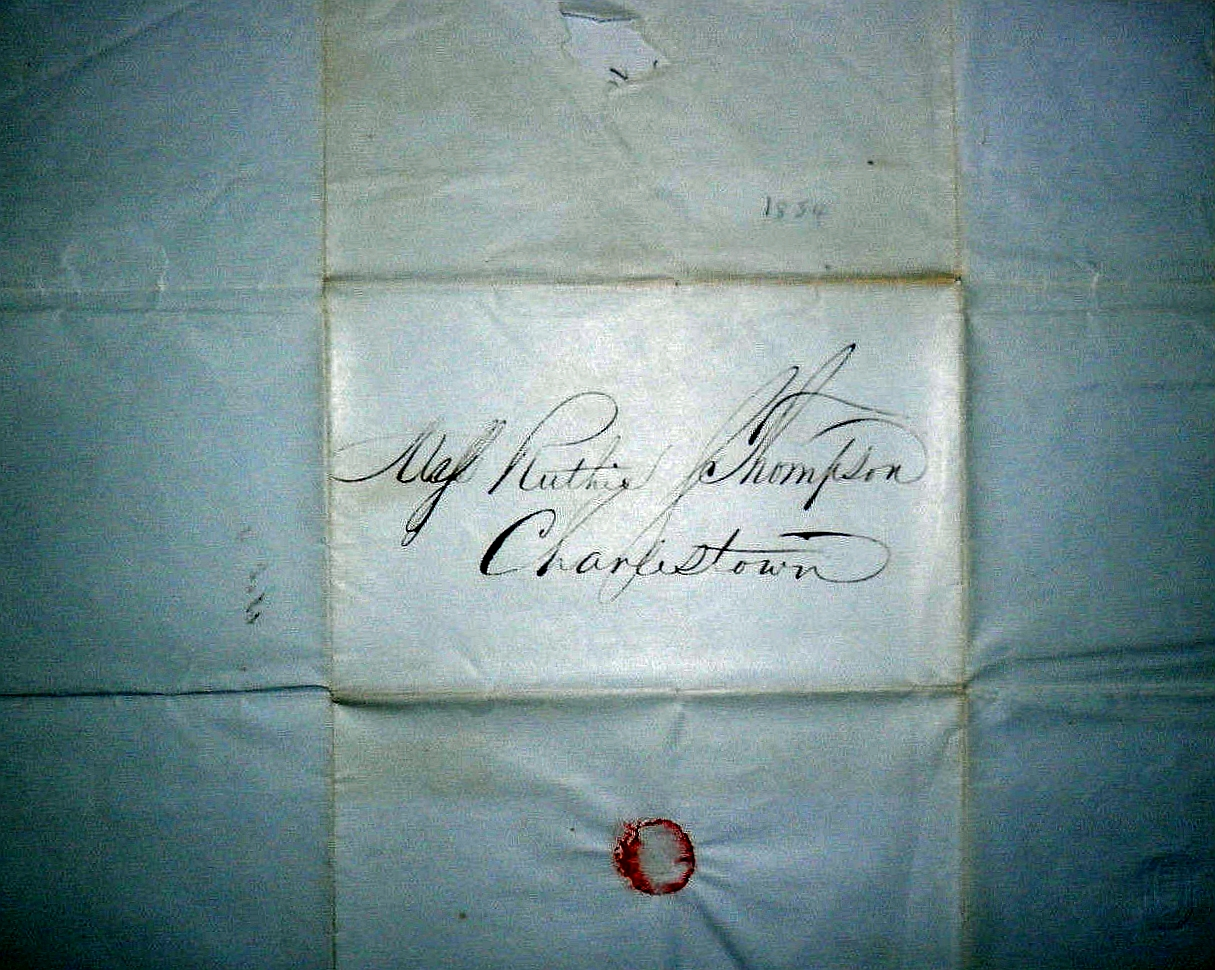
A letter sold on Ebay, 2016[3]

On a Sunday morning in January 1859, Frank Thompson, a visitor to Baltimore from Charlestown, Massachusetts wrote a letter to his wife Ruthie, describing the adventure of his train ride from home to the President Street station. The first three legs of the journey were very pleasant. He was accompanied by some local notables and acquaintances from home, stayed overnight in New York, where he smoked and talked into all hours, and went on to Philadelphia the next morning. From there to Wilmington Delaware he still had people he knew to talk with, but after Wilmington, “being alone,” he moved to the smoking car, the last car in the train, where he encountered men of a different sort:

Soon after [I got there] much to my surprise some 15 to 20 of the worst looking fellows came & began to carouse, having a bottle [of] whiskey. They soon began passing around said bottle (without glasses). I declined the honor of a drink as politely as possible, fearing to offend. Soon after the leader of the crowd came & took a seat next to me & commenced conversation by informing me that one of the number (who at that moment was very drunk) had just been discharged from custody on charge of murder in Phila, the evidence not sufficient to prove it, although I have no doubt he was guilty. My friend also informed me that he was one of the Balto police and a great scoundrel … On the first chance I left the Car, but not before my friend, who informed me that his name was Tom Gorman, assured me that if I ever got into any scrapes in Balto, to send for him ...which I promised to do. That nice fellow (the conductor, afterwards informed me) was [of] a delegation of the celebrated “Plug Uglies’ club of Balto who had been on to Phila to escort their friend (the murderer) back to Balto[4]

Frank made it back safely to Charlestown to his wife and young daughter.[5]

Carpenter’s Alley in 1851 in the 14th Ward

From the revised Thomas Poppleton Map

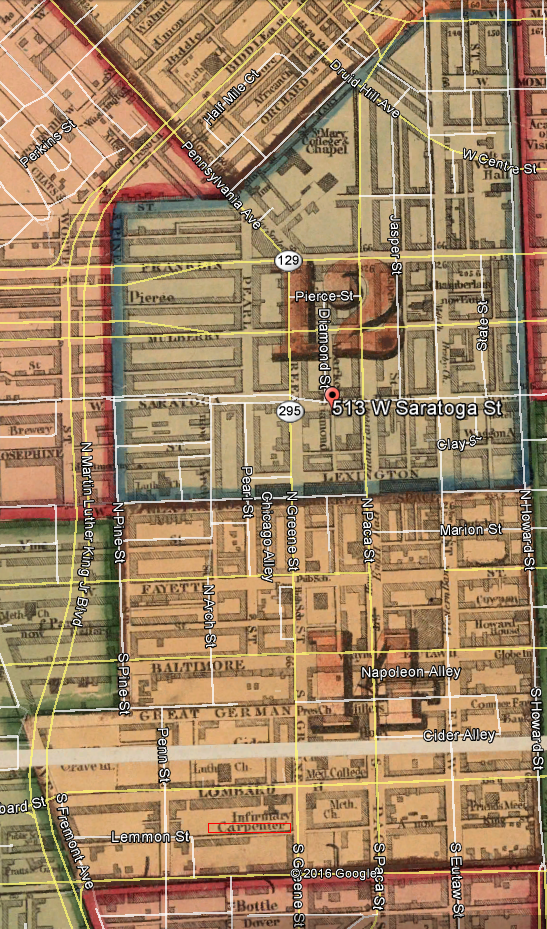
“Tom” Gorman, born in Pennsylvania, first appears in the public records of Baltimore City as a constable (1848)[6] and then as a concerned citizen. In 1850, according to the city directory, he lived at 204 Saratoga Street in the 12th ward (what today is 513 West Saratoga), and is identified as a police officer. In 1854 he dropped his protest over a steam mill being erected on Carpenter’s alley, an alley that ran from Fremont to Howard street in the 14th ward of Gorman’s day, but which today survives only as a fragment of its former self called Lemmon street.

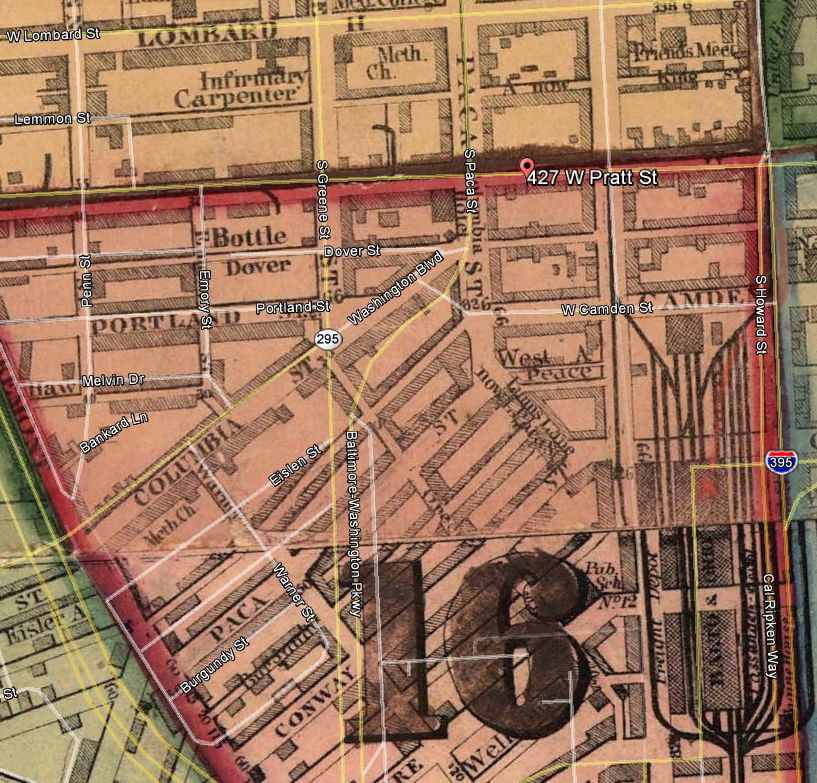
From the revised Poppleton map of Baltimore, 1851-5,

with white and yellow lines depicting current streets, and large numbers indicating the ward.

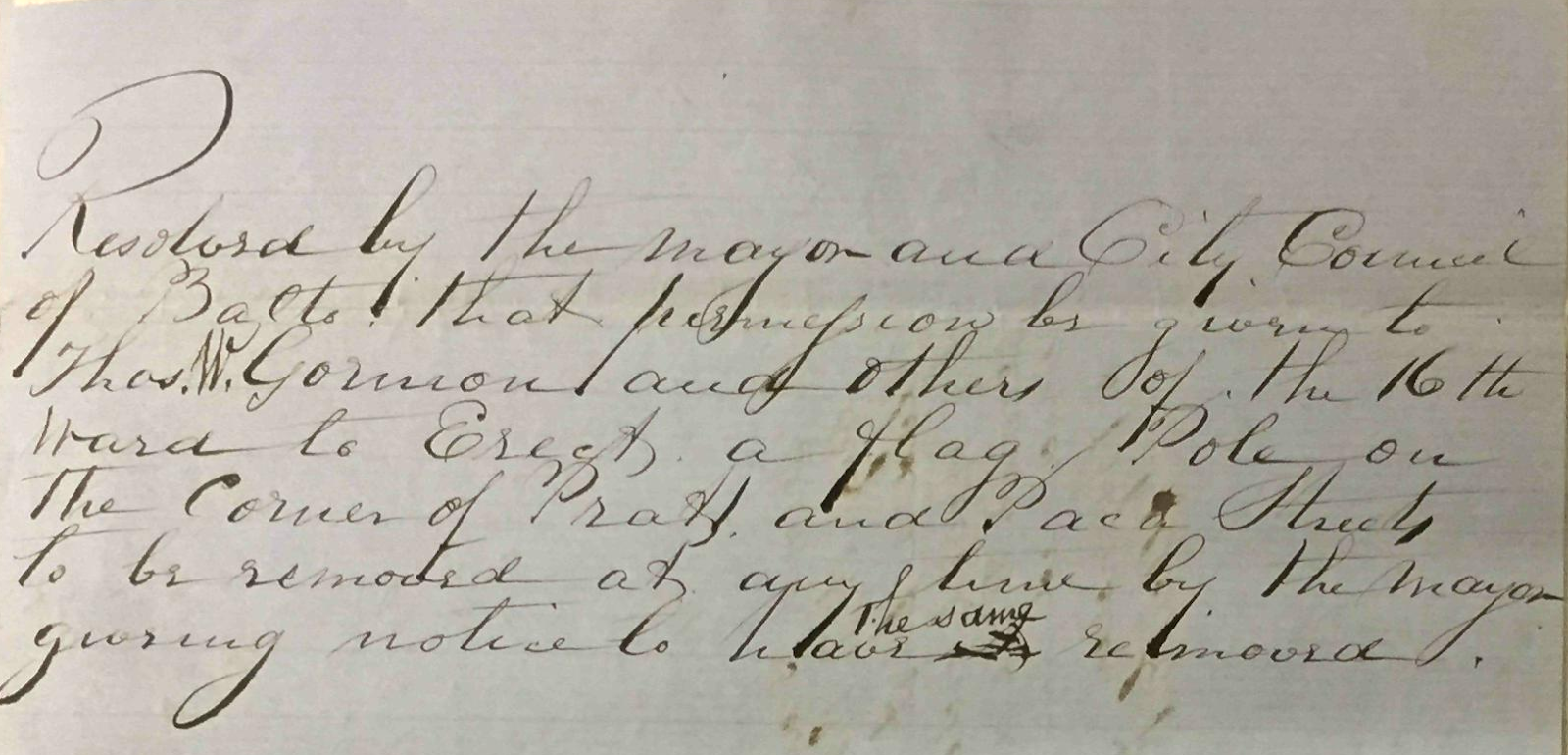
By 1859, Tom Gorman was living at his restaurant at 317 West Pratt Street in the 16th Ward, what today would be 427 West Pratt, and working as a police detective out of an office on Pleasant Street in or near City Hall. He had been appointed one of the first city-wide police detectives in 1858, and had clearly shown his patriotism by gaining city permission to erect a flagpole near his restaurant on the corner of Pratt and Paca. In all likelihood his restaurant was a center of political activity for both the 14th and 16th wards.[7]

Baltimore City Archives, BRG32, series 1, 1856, item 857

Baltimore City Archives, BRG 32, Series 1, 1856, item 259

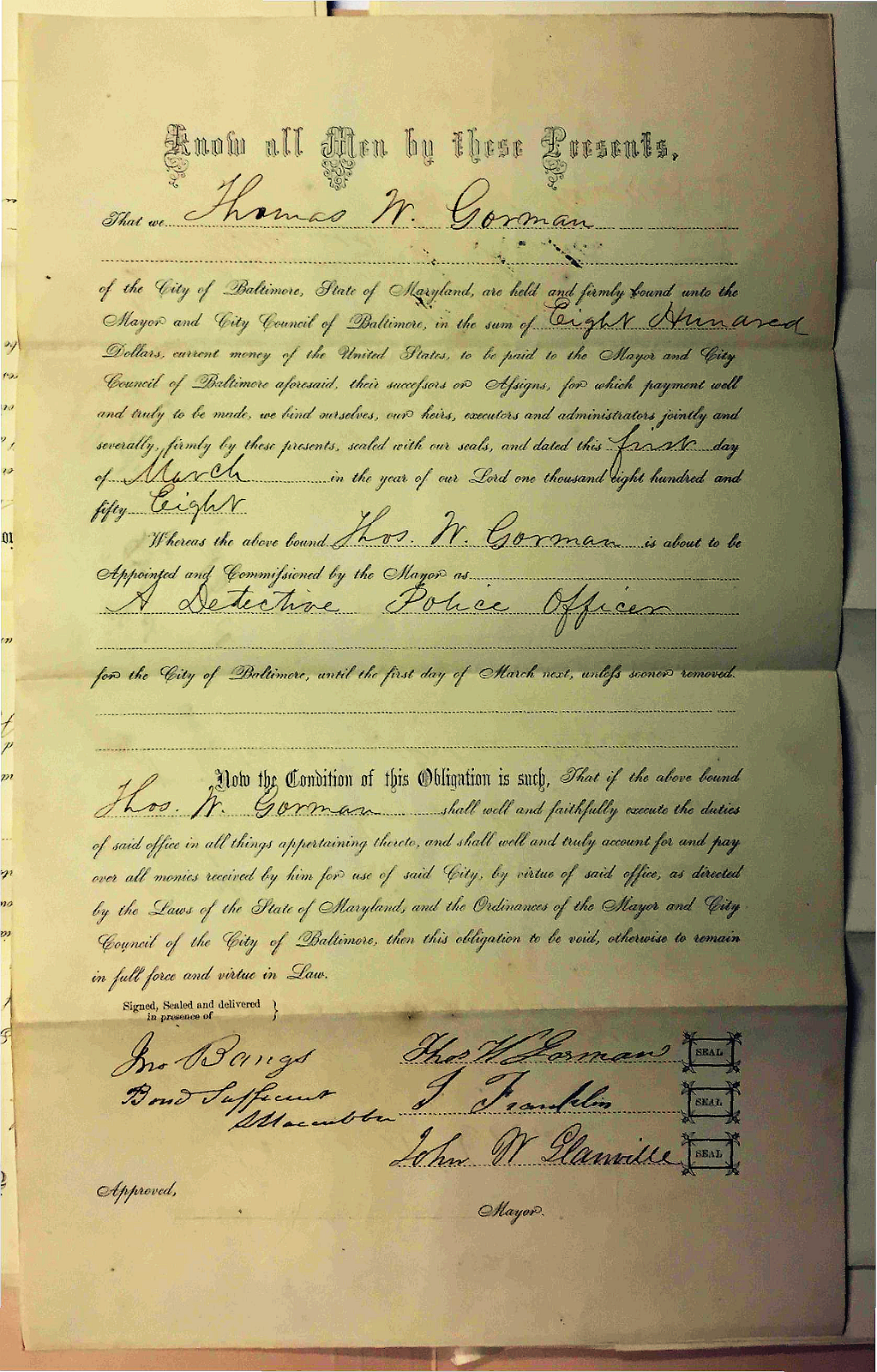
In order to become a detective, Tom Gorman had to post an $800 bond, a fairly steep entrance fee for his new job. An interesting story may lay behind who were his sureties.

Baltimore City Archives, BRG 16, Series 1, item 429

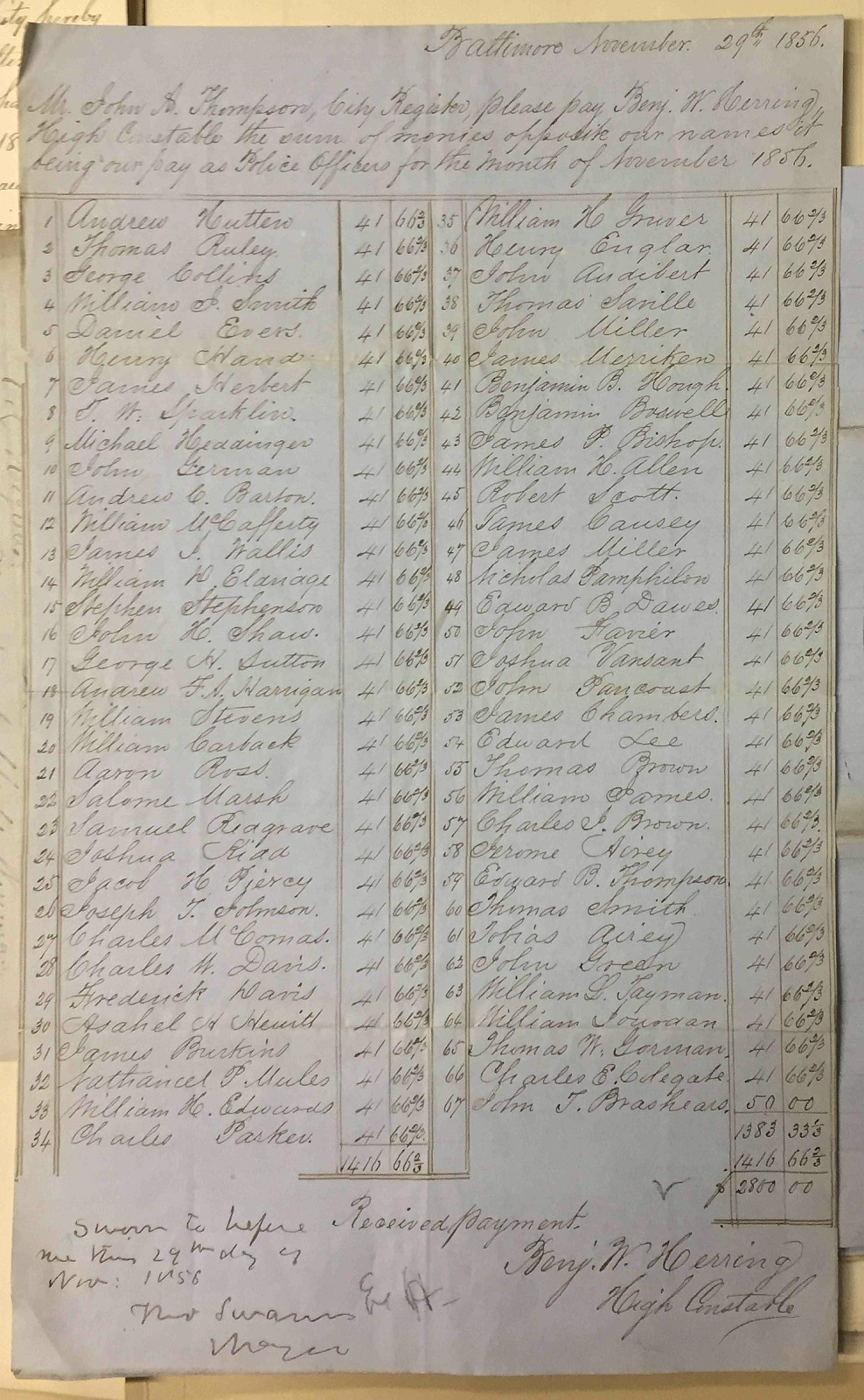
Tom Gorman did not appear to make much money as a constable or a detective. His name appears on a constable’s payroll for 1856, and is said to appear on the payroll for 1860 which has gone missing since it was inventoried by the Works Progress Administration in the late 1930s. In 1856 his salary was $41.66 a month or $500 a year. What he was paid by 1860 as a plainclothes detective was $10 a week or $520 a year,[8] not much of an increase, but he supplemented his income at his restaurant, and perhaps in other ways, some of which may not have been legal.

1860 was a tumultuous year for the Baltimore City Police department. That year the State conducted an extensive investigation into voter fraud and intimidation by the dominant political party in the city, the Know Nothings, that may have been abetted by the Police.[9] According to a history of the Baltimore Police published in 1888,

the [police] force was gradually filled [after 1857] with " Know-nothing" recruits, who, instead of maintaining the peace, became willing tools of violence and riot. Thus, in many instances, the men sworn to enforce an observation of the law became the chief instruments in subverting it. For several years the city was given up to a mob. At every election, riot swept many quarters of the city. Because of these facts a committee of the Reform party in 1859 drafted a number of bills, known as the "quot;reform bills," and among these was the police bill.[10]

As civil war approached and pressures increased for Maryland to secede from the Union, Detective Gorman garnered considerable press, local and national, for his success at apprehending criminals. In his first year as a detective he arrested a forger of a $384.75 bank draft who posed as traveling lightning rod salesman and who was found by Gorman in bed with his male accomplice at Columbia House at the corner of Pratt and Paca, not far from Gorman’s restaurant.[11]

Odd Fellows Hall on North Gay Street, 1864

Detail from the Sanborn Insurance Maps of Baltimore, 1879/1880

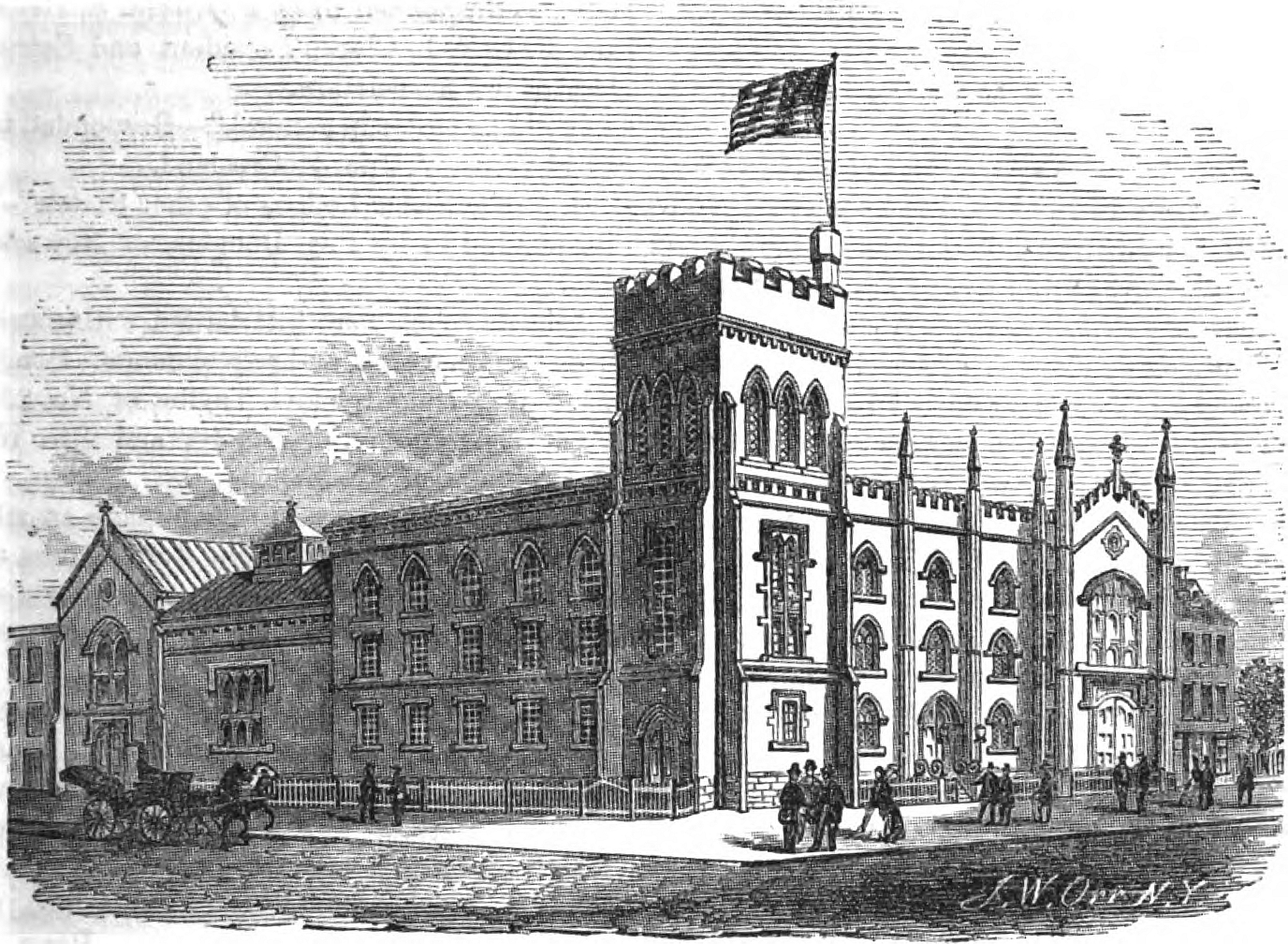
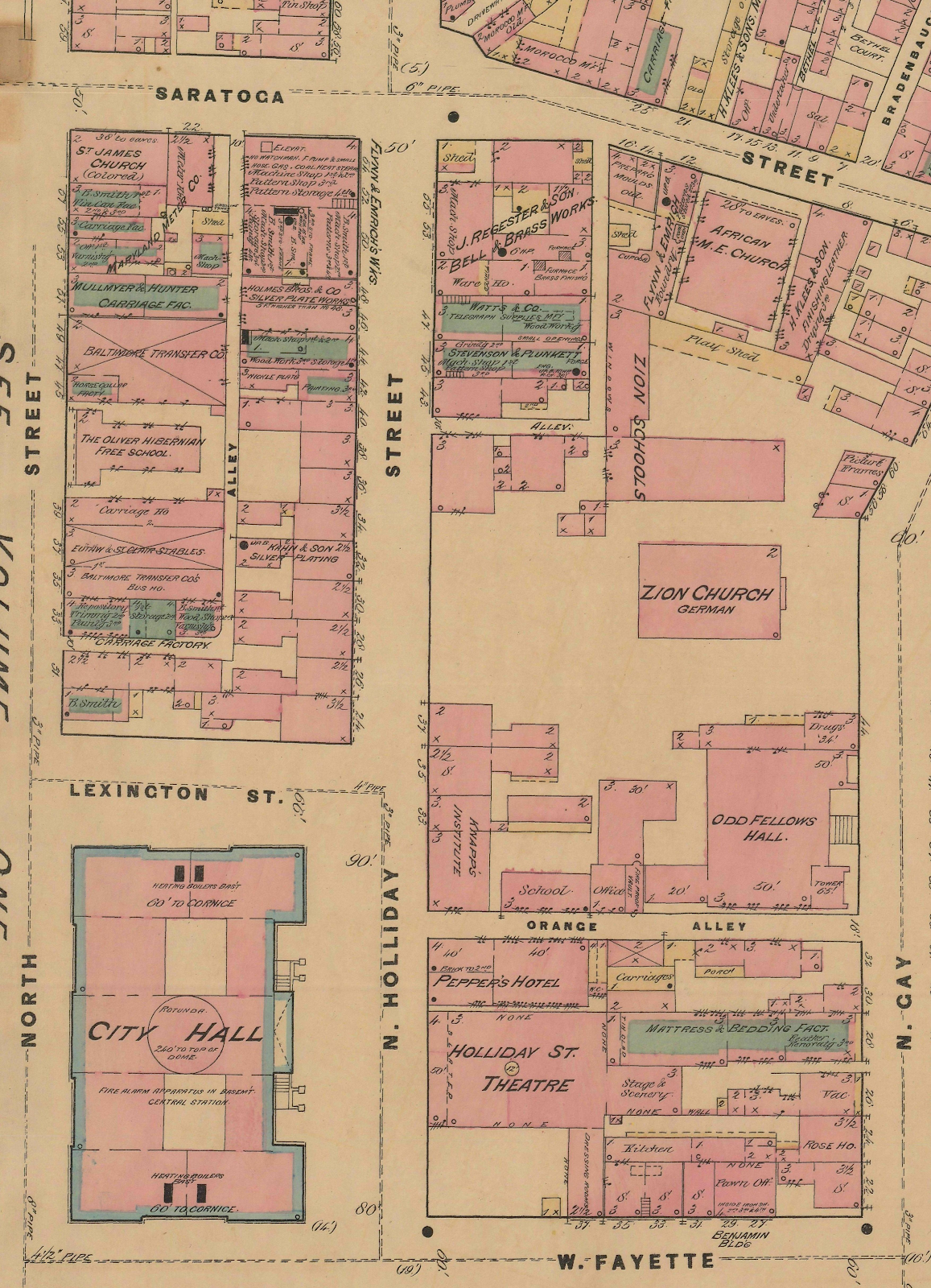
In February 1860, Detective Gorman gained national recognition for foiling the attempted robbery of Thomas Wildey[12], founder of the Independent Order of Odd Fellows, a wealthy organization that had built a large and impressive building not far from City Hall and Detective Gorman’s office. The National Police Gazette, published in New York, reported in its February 18, 1860 issue that on February 10 Grandsire Wildey (in his late70s) was returning home

From the Holliday Street Theatre, and as he was stepping into a city railway car, an attempt was made by two notorious pickpockets to rob him. The “old king,” however, was a little too wide awake, and detected the hand of one of them in his pocket, and called for aid, when the fellow was nabbed by Tom gorman, who happened to be on hand. He proved to be -- Brown, one of the most noted pickpockets and villains in the city. The other was Reese, especially noted in the same line, and the man who personated Flim Flam, and aided his escape from the County prison some time ago. This villain was supposed to be in jail, but it seems he has been discharged on bail, and allowed to continue his course. Both of these men belong to the Holliday street party, and it was near that den that the robbery was attempted.[13]

In that same issue the Baltimore correspondent goes to great length to describe the tribulations of the police department suggesting that Tom, as a member of the old guard would have been displaced by a new appointment under the recent law that placed the police department under the control of the State, if the Mayor had not refused to recognize the new board and kept the old police force at work.

It seems that Detective Gorman made more than one trip to Philadelphia to retrieve criminals. In August 1860 he brought back a burglar, Charles Everett, alias White, alias the Doctor, a fugitive from justice accused of burglarizing several Baltimore establishments including the auction house of Samuel H. Glover, the bacon house of Messrs. McConkey & Co., and the store of Mr. White. Everett was sent to jail to await the action of the grand jury.[14]

On November 28, 1860, Deputy Marshall Gifford, Detectives Stevens and Gorman, and policeman White investigated a robbery of $30 worth of clothing at Archibald Stirling’s on Hillen Road. They were able to find the tracks of the gig (a vehicle with two wheels drawn by a horse). They found the tracks

on the Harford road to Aisquith st. and thence along the wall of Greenmount cemetery to the tunnel under the York road, near that point. It appears that there was so much water in the tunnel that the thieves concluded it was not a safe place, and went up on the hill near the cemetery and concealed the clothing in a sand bank, where it was all found. The gig was found some distance up the York road, where it had been left after burying the stolen clothing. No clue has yet been obtained as to who were the perpetrators of the robbery.[15]

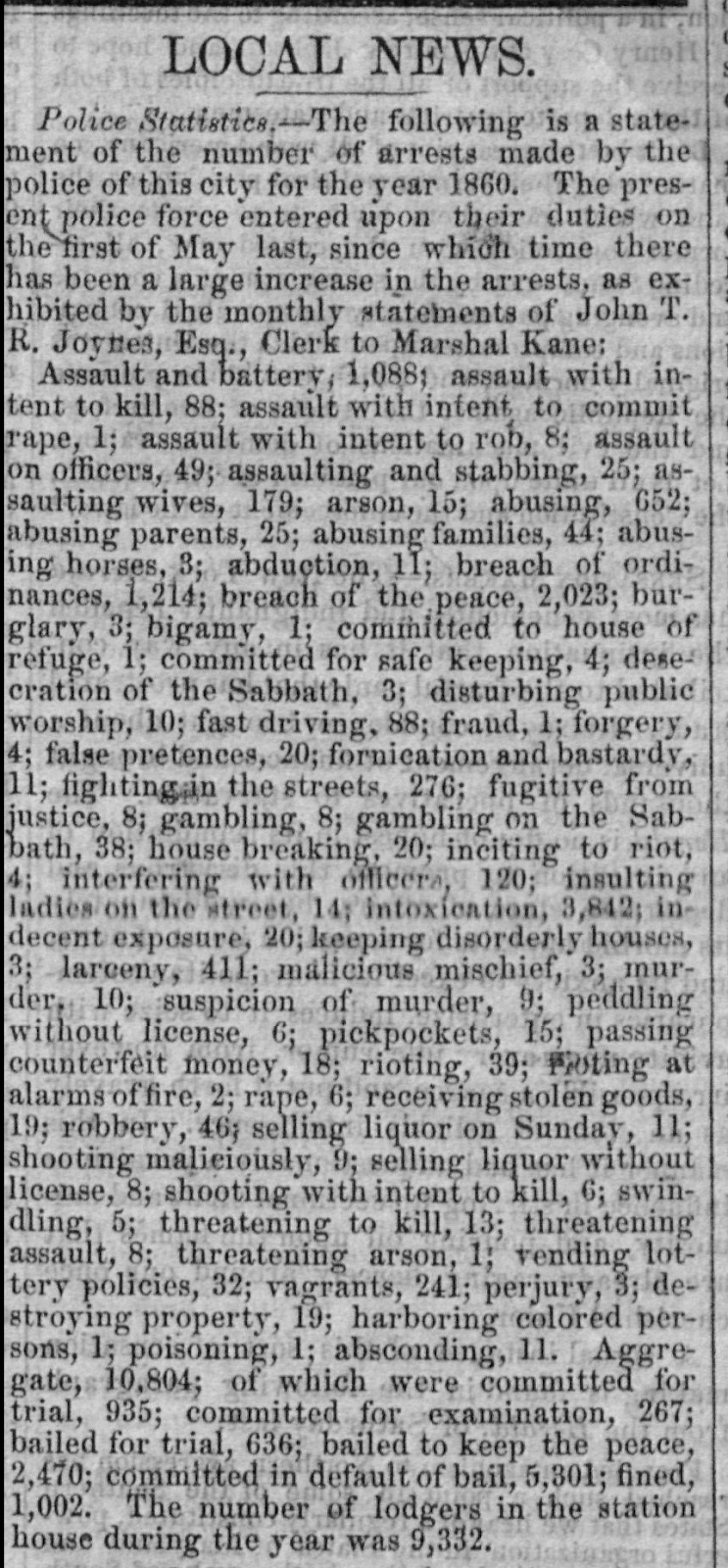
Marshall Kane's Crime Statistics for Baltimore for 1860, Baltimore Clipper, January 1, 1861

It would appear from the Baltimore Clipper, that until late June of 1861, Detective Gorman continued to pursue pickpockets and other robbery suspects, but those accounts stop suddenly with the arrest of Marshall Kane and the Union interests take over the Police Department.

Kane and then the Mayor, George William Brown, were thrown into prison and deported from the City without benefit of an appearance in court (they were prevented by the military from availing themselves of Habeas Corpus). As Mayor Brown later recalled:

On the 10th of June, 1861, Major-General Nathaniel P. Banks, of Massachusetts, was appointed in the place of General Cadwallader to the command of the Department of Annapolis, with headquarters at Baltimore. On the 27th of June, General Banks arrested Marshal Kane and confined him in Fort McHenry. He then issued a proclamation announcing that he had superseded Marshal Kane and the commissioners of police, and that he had appointed Colonel John R. Kenly, of the First Regiment of Maryland Volunteers, provost marshal, with the aid and assistance of the subordinate officers of the police department, the police commissioners, including the mayor, offered no resistance, but adopted and published a resolution declaring that, in the opinion of the board, the forcible suspension of their functions suspended at the same time the active operation of the police law and put the officers and men off duty for the present, leaving them subject, however, to the rules and regulations of the service as to their personal conduct and deportment, and to the orders which the board might see fit thereafter to issue, when the present illegal suspension of their functions should be removed. [16]

Detective Gorman was out of work After having his successful arrests recorded on the front pages of the Baltimore Clipper ten times between January and May 1861 and having been sent by Marshall Kane only a few days after the April 19th riots to report on the retreat to Harrisburg of the Pennsylvania militia, he was relegated to hiring himself out as doorkeeper and private detective at the Maryland Institute fair where he was attacked by three rowdies.[17]

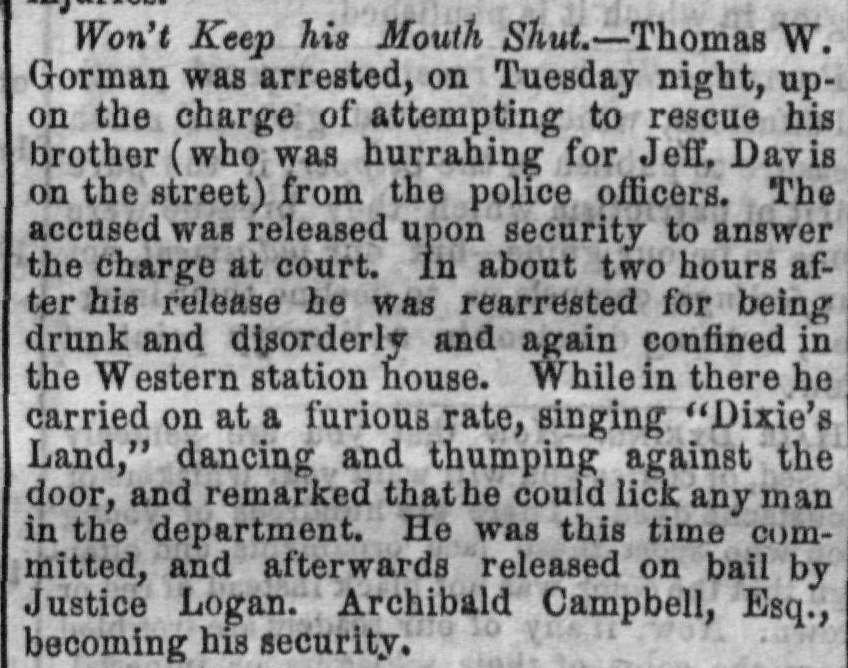
Is it no wonder that he took to drink, was arrested for brawling, and for his vocal support of the Southern cause?

The last the public in Baltimore heard of former police detective Tom Gorman was in flight:

BALTIMORE, MD., May 25 [1862]

THE excitement and exasperation of feeling that has been smouldering in this city ever since the memorable scenes of April, 1861, culminated yesterday in acts of violence and serious breaches of the peace….

In the course of the morning, Thomas W. Gorman was observed standing in the portico of the City Hotel, when a crowd started in pursuit, but they were not quick enough, for he managed to escape by a private entrance.[18]

Oakdale Cemetery, Wilmington, North Carolina

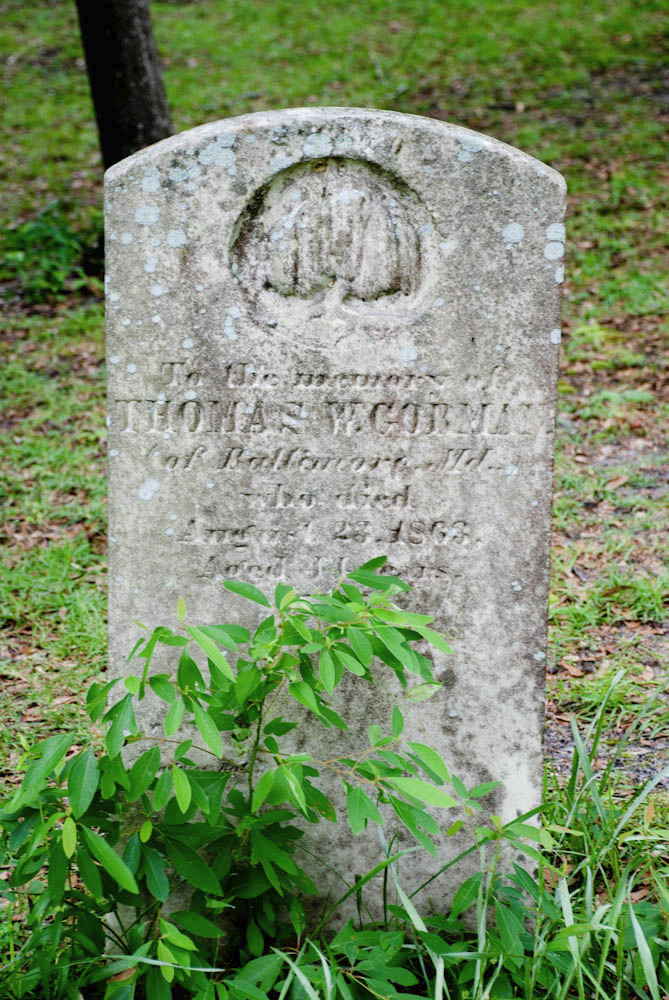
What happened to Detective Gorman next is not known for certain, but it is likely that he went South to join the Confederacy as did his chief, Police Marshall George Proctor Kane (1817-1878), later the 26th mayor of Baltimore (1877-1878).[19] That he was dead by August 1863 in Wilmington, North Carolina, is suggested by an undocumented tombstone.[20] His family remained in Baltimore. His son William, according to the 1870 census, became a teacher, and Fannie, Tom Gorman’s wife, who lived for at time with her son, never re-married. She died in 1902 at the age of 79 and was buried in Western Cemetery as was her daughter-in-law the year before. In her later years she may have lived alone near her daughter-in-law, also named Fannie, with one or the other of them earning a living as a seamstress.[21]

In all Tom Gorman’s life in Baltimore encompassed one of the more raucous and strained times in the City’s history, one in which the city was ruled by an unruly democracy and served, perhaps, by a not always honest constabulary. Jean H. Baker, William Evitts, and Tracy Matthew Melton have provided excellent historical contexts for Tom Gorman’s world in the years leading up to the Civil War, and are required reading for guidance in understanding the politics of that era.[22] The surviving evidence of Tom Gorman’s life provides additional and personal insight into the day to day experiences of those who lived during those times, helping us to better understand the rhythm of city life in the context of where people lived and worked.

That we know as much as we do about Detective Tom Gorman’s life in those divisive times is due to fragmentary evidence scattered in many places, some of which is only available on the internet, and all of which is threatened by the instability of the electronic world and the inadequate care of underfunded, understaffed, and in some cases, failing archival institutions.


[3] image courtesy of David Chesanow

[4] quotation courtesy of David Chesanow, transcribed from the image provided on Ebay

[5] Considerable details about the Thompson family can be found on Ancestry.com. I wonder if any of the rest of the family correspondence has survived?

[6] The Baltimore Sun, 1849/09/15, p. 2

[7] In the 1860 census Detective Gorman, age 39, is living with his wife Annie (Fannie/Fanny?), age 35, and two sons, John, age 11, and William, age 15, in the 14th Ward. The ward designation is probably an error. The restaurant was just across Pratt street in the 16th ward. The 1850 census, when he was living in the 12th ward at 204 Saratoga, Thomas W. Gorman was listed as a white male born in Pennsylvania, age 27, with a wife Fanny, age 26, and two sons, William, age 4, and John age 1. See Ancestry.com for images of the census schedules. In order to translate the street addresses of the 1850s and 60s to their location today, see: R. L. Polk & Co’s Baltimore City Directory for 1887. It appears to be the only year that the city directory provided conversion tables by street name of old addresses to new, with old numbers first and new numbers preceded by *.

[8] de Francias Folsom, Our Police ..., 1888, p. 29. Folsom’s history is available on the web at https://archive.org/details/ourpolicehistory00fols. For an extensive and informative study of the Baltimore Plug Uglies, see Tracy Matthew Melton, Hanging Henry Gambrill, The Violent Career of Baltimore’s Plug Uglies, 1854-1860, Baltimore: The Maryland Historical Society, 2005.

[9] For a study of the unsuccessful court case brought to prevent the State takeover of the Baltimore City Police Department see: "Displaced by a force to which they yielded and could not resist": A Historical and Legal Analysis of Mayor and City Counsel of Baltimore v. Charles Howard et. al by Matthew Kent, 2011, and The Baltimore Police Case of 1860 by H. H. Walker Lewis, 1966, Md. L. Rev. 215.

[10] More needs to be done with investigating the individuals mentioned in the legislative investigation of the police in Baltimore and the court cases that followed the act transferring control over the police to the State. The court cases are to be found at the Maryland State Archives.. For an extensive study of the Plug Uglies and Police involvement at the polls see Tracey Melton … and Walker Lewis. For the best histories of Maryland in this period including Baltimore politics, see Baker, Evitts,

[11] Baltimore Sun, 1858/03/05, p. 1. In 1859 Columbia house is listed in the 1860 City Directory as: BLANCK JOHN, Columbia house, 471 w Baltimore. From the city directories it appears that Columbia House moved around to different locations suggesting that it was not the most reputable of boarding houses or hotels.

[12] Thomas Wildey (1782–1861) was the founder of the Independent Order of Odd Fellows (IOOF) in North America in Baltimore in 1818. See: https://en.wikipedia.org/wiki/Thomas_Wildey and http://monumentcity.net/2009/05/25/thomas-wildey-odd-fellows-monument-baltimore-md/, another blog that may well disappear in time. The Baltimore monument to the Odd Fellows and Thomas Wildey is to be found at N Broadway & E Fayette Street, south one block (Street View) GPS: 39° 17′ 36.19″ N 76° 35′ 38.24″ W. Thomas Wildey died in October 1861 at his residence at the northwest corner of Gay and Fourth Streets in Baltimore.

[13] The National Police Gazette, February 18, 1860.

[14] Baltimore Sun, 1860/08/27, p. 1

[15] Baltimore Sun, 1860/11/28, p1. There are other mentions of Tom Gorman in the Sun, and they will also be found in the American and the other newspapers of the day that are not available on line with ocr’d text indexes. This particular chase took place in the Northeastern Police District. Tracy Matthew Melton in Hanging Henry Gambrill. Baltimore, 2005, consulted all the extant newspapers for the period when Gorman was a detective, but did not mention him or his connection to the Plug Uglies and Know Nothings. The newspapers published in Baltimore between 1855 and 1865 are listed by Jean Baker, The Politics of Continuity, Baltimore, 1973, pp. 223-224, and William Evitts, A Matter of Allegiances, 1974, p. 198. Only the Baltimore Sun is adequately indexed on line. The Baltimore newspapers that will prove helpful to following Tom Gorman’s career, are the American, the Daily Gazette, the Baltimore Clipper (a Know Nothing newspaper), and the two German language dailies, Der Deutsche Correspondent and Baltimore Wecker. Images of the American (various titles) and the Der Deutsche Correspondent are on line through Google, https://sites.google.com/site/onlinenewspapersite/Home/usa/md, while the surviving images of the Baltimore Clipper are available from the Maryland State Archives: M8521 - March 3, 1847 - December 31, 1863; M8522 - January 1, 1864 - December 31, 1864; M8523 - January 2, 1865 - September 30, 1865, and original scans presented in pdf format. Sadly, no reasonably accurate on-line ocr text generated index is planned for these newspapers, making it very difficult and time-consuming to trace individuals named in their pages. Generally speaking even if ocr text indexing is available based upon the microfilm, the results are spotty. As I tried to explain in the sample I provided on line of the American for 1814, the original newspapers that have survived need to be scanned on flatbed scanners using a method I developed to preserve the paper when it is passed through the scanner and then ocr’d using ABBYY or some other good ocr program. I took sample images of the Clipper that had been scanned to the standard I set at MSA and ocr’d them with Abbyy myself at home. As a result I was able to locate quickly several articles that related to Tom Gordon that are referenced here. It is sad that Archival repositories that have original newspapers do not follow the example I set. It is in their best interest to do so.

[16] Brown, George William. Baltimore and the Nineteenth of April 1861: A Study of the War. Baltimore: N. Murray, 1887. <https://archive.org/details/baltimoreninetee00browuoft>, pp 97-98.

[17] See: http://virtualarchive.us/documentation/gorman_tom_clipper.pdf for a compilation from the Baltimore Clipper of the mention of Tom Gorman in 1861.

[18] Frank Moore, The Rebellion Record, Vol 5, New York, 1866, p. 430. Images from the Baltimore Clipper will be added in the near future to this post with citations that will document Gorman’s difficulties following his probable ouster as one of Baltimore’s first detectives.

[19] See: https://en.wikipedia.org/wiki/George_Proctor_Kane, http://www.findagrave.com/cgi-bin/fg.cgi?page=gr&GRid=52324567, and http://msa.maryland.gov/megafile/msa/speccol/sc3500/sc3520/012400/012478/html/12478bio.html

[20] It is not certain that this is the grave of Detective Tom Gorman from Baltimore. There is a Mary Gorman buried in this cemetery who died in 1866. Perhaps Tom had relatives in Wilmington who he was visiting when he died in 1863, or perhaps this is another Thomas W. Gorman, although the coincidence of the Baltimore reference, and the age of the deceased, strongly suggests it may very well be the detective.

[21] Based on census records in Ancestry.com and http://www.findagrave.com/.

[22] William J. Evitts,A Matter of Allegiances: Maryland from 1850 to 1861. Baltimore: Johns Hopkins University Press, 1974, Jean H. Baker,The Politics of Continuity; Maryland Political Parties from 1858 to 1870. Baltimore: Johns Hopkins University Press, 1973, and Ambivalent Americans: The Know-Nothing Party in Maryland. Baltimore: Johns Hopkins University Press, 1977, Tracy Matthew Melton,. Hanging Henry Gambrill: The Violent Career of Baltimore's Plug Uglies, 1854-1860. Baltimore: Maryland Historical Society, 2005. For anyone interested in the history of the Baltimore police before the Civil War see the topical analysis of the surviving records in a public archives at: https://baltimorecityhistory.net/police-records/. Also it has been brought to my attention that for the Southern District the desk sergeant's log of events in that district for 1850-1853 is available in Special Collections at the Albert O. Kuhn Library. See: HV8148.B2 B35 1851.